Additional Comments on Questions
Additional Comments attach a follow-up text field to a question in a TrueContext form. The comment field appears when a user selects an answer that matches criteria you define — for example, when an inspector marks an item as Failed or enters a reading outside the acceptable range. Use Additional Comments when you need a structured reason or corrective action tied directly to a specific answer, without building Conditional Logic rules.
Available on all tiers:
Contents
When to use Additional Comments
Additional Comments are useful when specific answers need extra context. Common scenarios include:
- An inspection question with Pass, Fail, or Not Applicable options. Selecting Fail reveals a required comment field asking for the reason.
- A numeric reading from equipment that falls outside the ideal range. The comment field prompts the user to enter a corrective action.
Additional Comments offer two key benefits over Conditional Logic:
- The comment answer is tied directly to the question that triggered it, which produces more structured form data.
- You can build them without Conditional Logic rules, which keeps forms easier to manage.
How Additional Comments appear on a mobile device
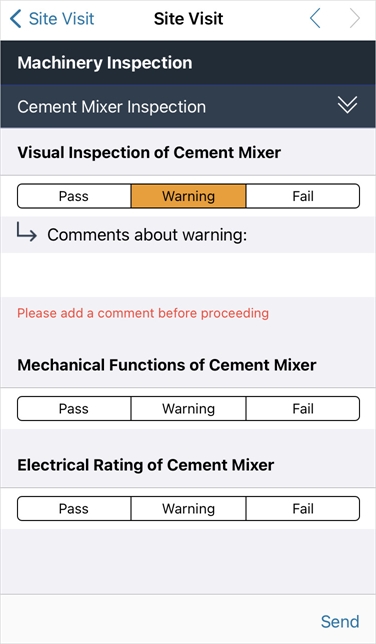
Additional Comments appear on the Mobile App as a text field or text area. The field appears when the user selects an answer that matches the criteria set by the form designer.
For example, in an inspection form, selecting Warning reveals a comment field beneath the question. The user fills it out to provide more detail.
Supported question types for Additional Comments
You can add an Additional Comment to the following question types:
- Button Group, Dropdown, Radio Button
- Text Field, Stepper, Slider, and Calculation: These questions must use a numeric data type—integer, decimal, or other number-based type. Additional Comments for these question types are tied to Exceptions. You must apply an Exception to the question before you can add an Additional Comment. In the Mobile App, the comment appears when an answer matches a defined Exception.
Info:Go to Answer Exceptions for details on how Exceptions work with numeric questions.
Set up an Additional Comment in the Form Builder
-
Open the form in the Form Builder and go to the question you want to add a comment to.
-
Select the Properties tab.
-
Switch on Additional Comments.
Note:For Text Field, Stepper, Slider, and Calculation questions, you must apply Answer Exceptions to the question before you can switch on Additional Comments.
-
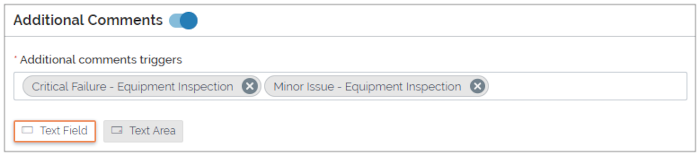
Under Additional comments triggers, select the answers or exceptions that trigger the comment field. You can select multiple options.
-
Select if you want to capture the comments in a Text Field or Text Area. With a Text Field, mobile users can enter a single line of text. With a Text Area, mobile users can enter multiple lines of text.
Note:If you select Text Area, you can also turn on Rich Text to make Additional Comments support rich text. Go to Add Rich Text formatting to Additional Comments for details.
-
Under Question text for additional comments field, enter the text that shows before the Additional Comments field.

-
Select Required to ensure mobile users enter comments.
-
Select Save.
Result: The question prompts the user for Additional Comments. In the Form Builder, Additional Comments show under the question.

Add Rich Text formatting to Additional Comments
When Additional Comments use a Text Area, you can turn on Rich Text formatting to make Additional Comments support rich text. Mobile users see a formatting toolbar to add headings, bulleted and numbered lists, bold, italic, strikethrough, code, and quotes, and Additional Comments render any markdown content as styled text. Formatted content also renders as styled text in the Web Portal Form Submission details page and in generated PDF documents.
The Rich Text section appears below Additional Comments on the Properties tab when Additional Comments are turned on and set to use a Text Area. Rich Text formatting doesn't apply to Additional Comments that use a Text Field.
Info:Go to Set Up Rich Text Formatting and AI Text Transformation on Text Areas for setup steps.
Hide Additional Comments in output documents
When you set up a Word, PDF, or HTML output document, you can hide Additional Comments from the generated file. Hide them when the comments capture internal-only information that should not appear in customer-facing reports.
-
Go to the PDF, Word, or HTML document you want to configure. You can use a new or an existing document.
-
To create a new document:
Forms & Integrations > Documents > CREATE DOCUMENT
Select the type of document that you want to create.
-
To edit a document:
Forms & Integrations > Documents > Document Name > EDIT DOCUMENT
Info:Go to PDF, Word, and HTML Documents for details on setting up these document types.
-
-
Go to Formatting > Answer Format > Additional Comments.
-
Turn off Show additional comments in the document.
-
Select Create or Update to save your changes.
Result: Generated documents exclude all Additional Comments.
Dispatch data into Additional Comments
You can pre-populate Additional Comments when dispatching forms through the API. Use the following format to add Additional Comments to a dispatched question:
{
  "data": [{
    "label": "TireCondition",
    "answer": "Poor",
    "commentAnswer": "The tires are in poor condition due to extreme wear."
  }]
}
Where commentAnswer includes the Additional Comments.
Pre-populating Additional Comments through Web Portal Dispatching or Bulk Dispatching is not supported.
Info:Go to the Dispatch Forms API documentation for full details on how to Dispatch The term "dispatch" refers to the act of sending a form to a mobile user or customer. Typically, a dispatched record includes some information pre-filled to give the recipient context for the work to be done. Dispatch can be manual or automated (using a Dispatch Data Destination or the TrueContext REST API). forms through the API.